
UPI transactions reached 22.35 billion in April, marking a 25 per cent increase compared to April 2025. UPI now accounts for 85 per cent of all digital transactions in India and is live in eight countries.

'Being an important institution in the banking system, we are subject to regulatory supervision, both offsite and onsite.' 'When you look at the intensity at which these levels of supervision come, we, on the board and in management, believe there should not be any surprises.'

The Indian stock market is poised for a volatile week, influenced by the Reserve Bank of India's monetary policy decision, crucial global macroeconomic data, and the escalating geopolitical tensions in West Asia, according to market analysts.

India's forex reserves jumped $4.7 billion to $702.97 billion for the week ended September 12, the Reserve Bank of India said on Friday. In the previous reporting week, the overall reserves had increased $4.04 billion to $698.27 billion.

The Reserve Bank's gold reserves crossed 880 metric tonnes in the first half of 2025-26 with the central bank adding 0.2 metric tonnes in the last week of September. The total value of the gold was $95 billion as of September 26, 2025, according to the latest data from the Reserve Bank of India (RBI).

Governance uncertainty and leadership visibility gap are likely to keep the stock under pressure in the near term, said Nomura in a report.

Indian benchmark equity indices, Sensex and Nifty, extended their rally for a fifth consecutive session, driven by optimism surrounding a potential US-Iran peace deal and a significant drop in crude oil prices. Despite hawkish remarks from the US Fed, investors remain hopeful that easing energy prices could temper inflationary pressures.

India's forex reserves dropped $5.62 billion to $689.73 billion for the week ended October 31, the Reserve Bank of India said on Friday. The overall reserves had declined by $6.92 billion to $695.35 billion.

A 63-year-old retired Reserve Bank of India (RBI) employee was allegedly stabbed to death inside his residence in Delhi's Mandir Marg area. Police have launched an investigation and are exploring all possible motives.

RBI Governor Sanjay Malhotra stated that the central bank is closely monitoring whether the supply shock from the West Asia conflict will lead to a generalised price rise, potentially necessitating monetary policy action.

S Mahendra Dev, chairman of the Economic Advisory Council to the Prime Minister, expressed confidence that the rupee would stabilise around the 92-93 level against the US dollar, despite geopolitical tensions, and that foreign investment flows would return.
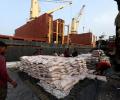
The Federation of Indian Export Organisations (FIEO) has appealed to the Reserve Bank of India (RBI) for liquidity support to Indian exporters, citing a significant increase in freight costs and extended payment cycles due to the ongoing West Asia conflict.

The Reserve Bank of India (RBI) has projected a 6.9 per cent GDP growth for the current financial year, citing concerns over commodity prices and supply chain disruptions stemming from the West Asia crisis.

India's wholesale price inflation (WPI) increased for the fourth consecutive month in February, reaching 2.13 per cent, primarily due to rising prices of food and manufactured goods, according to government data.

Fuel prices have risen by about Rs 7.5 per litre since May 15, as global crude oil prices surged due to the ongoing conflict in West Asia and supply concerns around the Strait of Hormuz.

India's forex reserves jumped by $3.29 billion to $696.61 billion in the week to December 26, the RBI said on Friday. The overall kitty had increased by $4.368 billion to $693.32 billion in the previous reporting week.

The Indian rupee rebounded 50 paise from its all-time closing low to settle at 96.36 against the US dollar, driven by retreating crude oil prices, signs of easing geopolitical friction, and likely central bank intervention.

The Indian rupee rebounded against the US dollar after the Reserve Bank of India (RBI) restricted banks' net open positions in dollars. This move prompted banks to sell dollars, providing temporary support for the rupee amidst ongoing geopolitical tensions and rising oil prices.

Following regulatory action against Paytm Payments Bank Ltd (PPBL), Paytm strategically separated its core operations, a move praised by analysts for preserving business continuity and governance. This separation has enabled Paytm to sustain growth and improve profitability.

'What exactly is on the prime minister's mind, we do not know. But it feels like the government wants the country to be prepared for unseen challenges ahead.'

The Reserve Bank of India (RBI) has reported processing 99.9% of applications under its Citizen's Charter within the stipulated timeframe in March 2026, demonstrating a high level of efficiency.

Cleaner balance sheets, regulatory support and strong growth prospects helped Indian private banks attract over $6 billion in foreign capital, with more deals expected in 2026.

The Reserve Bank of India (RBI) is exploring ways for Russian trade counterparts to use accumulated Indian rupees (INR) for imports or capital investments in India, aiming to boost INR-Rouble transactions and reduce reliance on the US dollar.

Unified Payments Interface (UPI) has reached a record Rs 314 lakh crore in transaction value in FY26, representing more than a 4,000-fold increase since inception.

Gwadar is viewed as a critical pearl in China's maritime strategy as it would give a permanent logistical footprint near an important choke point - the Strait of Hormuz and the oil rich Persian Gulf, explains Commodore Venugopal Menon (retd).

A husband and wife have been arrested in Delhi for allegedly murdering a retired Reserve Bank of India employee after he refused to lend them money.

The Reserve Bank of India (RBI) has projected that crude oil prices will average USD 85 per barrel and the rupee will weaken to 94 against the dollar by FY27, according to its bi-annual Monetary Policy report.
S&P Global Ratings has increased India's GDP growth forecast for the next fiscal year to 7.1 per cent, citing private consumption, investment, and exports as key drivers. However, the agency also cautioned that the conflict in the Middle East could strain India's fiscal position due to higher energy prices.
The Indian rupee rebounded against the US dollar after the Reserve Bank of India (RBI) restricted banks' net open positions in dollars. This move prompted banks to sell dollars, providing temporary support for the rupee amidst ongoing geopolitical tensions and rising oil prices.

The much-awaited board meeting of Tata Sons did not discuss listing of the holding company or a third term for Chairman N Chandrasekaran.

The case for long-term investment in gold, however, remains intact.

The measures announced by it risk backfiring, disrupting the foreign exchange market, and intensifying the very pressures they seek to contain, with broader consequences for the economy points out Rajeswari Sengupta.

Even if there is an early agreement on a cessation of hostilities in West Asia, the price shock will not go away easily, points out A K Bhattacharya.

Moody's Ratings has reduced India's GDP growth forecast for 2026 to 6 per cent, citing subdued private consumption, capital formation, and industrial activity due to higher energy costs and global uncertainties.

India's retail inflation marginally increased to 3.4 per cent in March, up from 3.21 per cent in February, primarily due to an uptick in certain food items and the initial impact of the West Asia crisis on fuel prices, according to government data.

The Reserve Bank of India (RBI) has proposed new measures to combat financial fraud in digital payments, including lagged credit for authorised push payments and a 'kill switch' for users to disable all digital transactions.

The Reserve Bank of India (RBI) is set to revise its directives for bank boards, aiming to alleviate operational burdens and enable them to concentrate on crucial policy and strategic decision-making, thereby enhancing corporate governance in the Indian banking sector.

The Reserve Bank of India (RBI) has opted to keep its key interest rates unchanged at 5.25%, anticipating a global economic recovery following a ceasefire in the US/Israel-Iran conflict, despite ongoing inflationary pressures and currency fluctuations.

Its strength is set to increase by 3 seats once the current round of Rajya Sabha polls for 27 seats are concluded on June 28.

'India has initiated a bear market and we will still go lower. It has nothing to do with the economy.'
